Translate

Sitio muy bonito y decoración espléndido
Bienvenida caliente y amable
Comida deliciosa - carne y pescado barbacoa una especialidad - selección excelente de vino
Mira el mundo pasando del patio al frente o disfruta las vistas estupendas de las montañas del balcón detrás.
Abierto Todos Los Dias Menciona Entresierra.blogspot.com y recibiras una bebida gratis

Beautiful setting and superb decor
Warm and friendly welcome
Delicious cuisine charcol grilled meat and fish a speciality
Excellent selection of wines
Bright and relaxing bar area
Watch the world go by from the front patio or savour the magnificent mountain views from the balcony at the back.
Open Every Day exept Monday

BOOKINGS PHONE 952869848

Telefono 952869848


Monday, 5 September 2011

Doctor serves six months in prison because of his grandmother's mothballs


mistaken positive in a drugs test carried out at Barajas Airport in Madrid has resulted in a Panamanian doctor, Juan Rodríguez Lizondro, to be imprisoned in Madrid for six months. The customs authorities and Guardia Civil declared that his 19 kilos of clothes had been impregnated with cocaine, while the doctor claimed they had detected his grandmother’s camphor. The reported conversation at the time was.... ‘It smells strange – what’s it got?’ ‘I don’t know. I live with my grandmother. She irons my clothes with starch, and then puts it in drawers with balls of camphor ro repel the moths – maybe it’s that’. ‘Let’s see’, said the Guardia Civil, who then sprayed the clothes with an aerosol which produced a distinctive blue colour, indicating as far as they were concerned that it was cocaine. The 34 year old doctor, who is a Seventh Day Adventist, had come to Madrid because of a three month scholarship he had won with the Carlos III Health Institute. He did not drink or smoke, much less take drugs. Despite that the prosecutor called for him to be charged with drug trafficking and the judge, who considered the aerosol test could not be wrong on 108 different items of clothing. A second test on the clothing at the Spanish Medicaments Agency took six months to come up with the correct result showing that there were no drugs. ‘I came to Spain with all my dreams and a grand project, and everything turned into the worst nightmare’.

Thursday, 11 August 2011

Spanish Government and Google In Court Over Right To Be Forgotten

While many in the United States are working on search engine optimization and crazy antics to get more and better hits on Google, there are at least 90 people in Spain who are doing just the opposite. The Spanish government, having ordered Google to remove people who attempted to “opt out” by sending formal complaints to Spain’s Data Protection Agency, is now engaged in a lawsuit with the Internet giant and the rift between European ideas of privacy and American ones has been brought to bear.

The whole issue started as a result of an official Spanish government gazette in which certain information about citizens is published by law. All was well and good until the gazette was digitalized and subsequently indexed on search engines at which point individuals have complained, citing their right to privacy and right to be forgotten.

It seems that people aren’t trying to opt out for trivial reasons. One example, given by The Register, is of a victim of domestic violence who found that her address was easily found through Google. Google, of course, is fighting to keep the information indexed as a matter of free speech. Google says that the removal of this information “would have a profound chilling effect on free expression without protecting people’s privacy,” and to a certain extent, I think they are right. I also think there is a very important detail missing from our knowledge of this whole proceeding: is there anyone who is advocating for this specific information being public?

The problem of removing information from Google searches is a real one, and the slippery slope implications scream potential censorship. First domestic violence victims opt out, then it’s domestic violence convicts, so on and so forth. However, in those cases, it would be safe to assume there would be an opposing voice. A convict tries to opt-out and a judge or the victim says, ‘No, I want that information to be available.’ Then we have an actual argument. Right now however, a victim of abuse wants her address information removed and Google is essentially saying ‘No, I want information in general to be available.’ If there is no one clamoring for her address specifically to be public, there seems to be no harm in letting it drift off the Internet.

All that being said, it is ultimately up to a court to decide. Whether or not it will really affect us here in the states is questionable, but the verdict is bound to set the European framework for the right to be forgotten in the digital age. Over here, we’re too into reality television to care that much.


EU allows crisis-hit Spain to restrict Romanian workers

Spain will now require Romanians to have a work contract before settling in Spain and reverses a two and a half year moratorium that gave Romanian workers unrestricted access as fellow members of the European Union.
The EU commission recognised that the measure was necessary “due to serious disturbances on the labour market in crisis hit Spain,” said a statement released by Brussels, Thursday.
The approval running to the end of 2012 marks the first time the “safe-guard clause” to restrict freedom of movement by EU member citizens has been invoked.
Spain suffers from the EU's highest jobless rate, running at over 20 per cent since May last year and rising to more than 30 per cent among Romanian nationals currently settled there.
The free movement of citizens from a new member state can only be restricted under certain conditions and Spain was asked to provide data to justify the implementation of the emergency curb.


Tuesday, 9 August 2011

British holidaymakers face travel misery as ground staff across Spanish airports threaten two days of strike action later this month.

More than 60,000 ground staff are threatening 24 hour walkouts on August 18 and August 26 which could cripple airports across Spain during the height of the holiday season.
The action will force delays and cancellations at all Spanish airports including Malaga, Alicante, the Balearics and Canary Islands, affecting hundreds of thousands of holidaymakers returning from their summer breaks.
The country’s main unions, CCOO, UGT and USO, support the strike action in a row over baggage handling contracts. It has been sparked following the decision by a private company at Barcelona’s El Prat airport to make four workers redundant.
A statement from the CCOO workers union confirmed the planned action: “The strike will affect every single Spanish airport, and will involve around 60,000 workers.”
The first day of the strike coincides with the arrival of Pope Benedict XVI in Madrid to lead World Youth Day celebrations. Up to a million pilgrims are expected to flock into the capital for the three-day papal visit.

In separate industrial action, Madrid’s underground rail workers have threatened to down tools on 18 August to protest over wage cuts.
Union chiefs have called emergency meetings with authorities to discuss the provision of “minimum services” at airports if the strikes go ahead. There was hope that they could still be averted.
Last December Spanish airports were brought to a standstill when air traffic controllers staged wildcat strikes forcing the military to take over and a “state of alert” to be declared. Further strike action over Easter was called off after a last minute deal was reached.


Monday, 1 August 2011

British funk band, Incognito, to play Salobreña

British funk band, Incognito, have chosen Salobreña for their only concert in Spain. It will take place on the Paseo de las Flores at 2230 on August 12 as part of the Tendencias festival.

The festival has been held for the past 20 years and has attracted many top national and international names, but this year is the first time it is to be held in the beautiful setting of the Paseo de Las Flores, close to the Salobreña Arab castle.


QUESTIONS were today raised as to why a man accused of murder in Tenerife was allowed to fly home without standing trial.


As revealed in the Echo, Andrew Crowther landed back in the North East at the beginning of this month after spending four years in a psychiatric hospital in Tenerife.

The 51-year-old was arrested in August 2007 on the Spanish island after his partner Margaret Manley, 40, was discovered in the apartment they shared in the popular Los Christianos beach resort. She had been strangled to death.

Mr Crowther, originally from Washington, was charged with her murder, which he denied, claiming he could not remember anything.

Despite never standing trial, on July 3 he was flown into Newcastle Airport and is now believed to be under a 28-day assessment order at a North East hospital.

However, it remains unclear what will happen to him at the end of the assessment, since he is not facing any criminal proceedings in this country.

Northumbria Police said their only involvement with Mr Crowther was with his transportation back to the UK.

It can also be revealed that Mr Crowther, a builder by trade, is not currently under the supervision of MAPPA, which manages offenders and dangerous people living in the region, as he is not technically a criminal in this country.

Martin Callanan, MEP for the North East, today said: “It’s extremely concerning that a man accused of murdering someone could be put back on the streets.

“But at the end of the day, if you’ve not committed any offence in the UK then it’s difficult to see what the British authorities can do about it.”

Mr Crowther is understood to be currently be under the care of Northumberland, Tyne and Wear Mental Health Trust and is being treated in a North East Hospital. It is possible that after the assessment he could be referred to MAPPA if he is deemed to be dangerous.

Mr Callanan added: “I would presume the relevant authorities are doing what they can but it is a difficult because if you haven’t committed a crime here in the UK then you can’t be detained for it.

“It’s a very difficult situation but, as I said, is extremely concerning.”

A Northumberland, Tyne and Wear Mental Health Trust spokesman said they were unable to confirm any details on individual cases.

A spokesman for the Foreign Office added: “We were aware when he was arrested at the time and provided assistance to his family but are not involved with anything else.”

Police have been attempting to contact Ms Manley’s next of kin.

EXPATS MUST make themselves legal in Spain to access the health system and qualify for the support it offers residents

EXPATS MUST make themselves legal in Spain to access the health system and qualify for the support it offers residents, a charity’s annual summer fundraising lunch was told.

Irene Ellis MBE, President of Cancer Care Javea, and Jan Elders, President of HELP International Benidorm and Honorary Welfare Officer of the RAFA North Costa Blanca Branch, were united in stressing the need to ‘go legal’ at the Expatriate Ostomates of Spain (EOS) event.
And supported by EOS President Cynthia Robinson, they advised expats should complete all the paperwork to insure they were in the system before calling for assistance.

At the lunch in Restaurante Amenecer, Javea, Cynthia accepted a generous donation from Cancer Care and said it would be used to benefit ostomates across Spain requiring both physical and emotional support.

Irene explained how Cancer Care had embarked on a new project, fundraising to provide Denia Hospital with the latest equipment to diagnose cancer – making detection of the disease quicker and more accurate through genetic analyses.

Tuesday, 5 July 2011

Amazing Spanish Rapa Das Bestas festival to tame wild horses

Wild horses are rounded up, trimmed and groomed in different villages in Spain's northwestern region of Galicia for the Rapa Das Bestas event every year on the first weekend of July.

Rapa Das Bestas, which means taming the beast, is an ancient festival of the region during which people wrestle untamed horses to the ground without using any weapon and cut their manes and tails.

The horse hairs collected during the festival are used for making household items such as brushes and mattresses.

Rapa Das Bestas festival 2011 took place in the village of Sabucedo in Spain on July 2, as visitors and locals gathered to watch the event.

Thursday, 30 June 2011

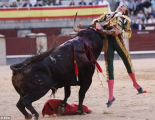
British writer risks death in the afternoon

The pavement outside a tapas bar in London's Old Brompton Road is a far cry from a bullring in Spain.

But that doesn't stop British writer, actor and amateur matador Alexander Fiske-Harrison from leaping to his feet mid-conversation and demonstrating a series of sweeping passes.

"There is no winning. It's not a fight," he says of the bloody Spanish spectacle. "It's a tragic play in three acts."

Fiske-Harrison, an Old Etonion and Oxford graduate, is following a line of non-Spanish artists to have been captivated by the "corrida de toros" that includes film-maker Orson Welles, critic Kenneth Tynan and, of course, Ernest Hemingway.

His just-published book "Into the Arena" sets out to explain the world of the Spanish bullfight and to examine its moral dilemma --the killing of an animal for entertainment.

It comes out at a time when the corrida is under sustained attack from animal rights activists in Spain and abroad and is feeling the effects of the country's economic crisis.

To get to the heart of the matter, Fiske-Harrison, 34, spent a year living in Seville and training as a matador, learning the cape passes and the technique of killing with the sword.

He took part in more than a dozen "tentaderos" -- private fights at bull ranches aimed at testing young bulls -- and finished by killing a three-year-old Saltillo bull before an audience of 100 spectators last November.

"I had qualms. There was a real possibility it could go horribly wrong. It just seems to me that if you are going to write, let's try to describe it properly. So I went for going over the horns. The moment of truth," he told Reuters.

Along the way he befriended matadors such as Juan Jose Padilla, one of Spain's most fearless, and Cayetano Rivera Ordonez, whose father Paquirri was killed in the ring in 1984 and whose grandfather Antonio Ordonez is one of the all-time greats.

He also hung out with breeders on the ranches where the bulls roam free until their date in the ring, including the Miura family, whose feared bulls have killed more matadors than any other breed.

He also tried his luck running with the bulls at Pamplona's San Fermin festival and will be there again in a few weeks time.

Fiske-Harrison, who wrote and acted in "The Pendulum" in London's West End before embarking on his taurine adventure, agrees with Hemingway's dictum that bullfighting is the only art in which the artist is in danger of death.

But, he says, the corrida is not about blood lust.

"The bull is not scared, it is fighting. It comes down to the elegance of the visual spectacle. The man standing rigid with this raging fury of blood and thunder going past him. And the danger, bringing it closer and closer.

"The matador evokes or inspires emotion in the audience."

Opposition to the bullfight -- not least in Britain -- is often hypocritical, he says. The bull has a better life and no less unpleasant death than beasts that are bred for the dinner table and slaughtered in abattoirs.

"We're not as into animal welfare as we like to think we are. We want a cellophane-wrapped steak from a supermarket. We'd rather not see it die," he says.

A ban on the bullfight would also be an environmental disaster. As well as spelling the end of a species bred solely for the purpose of the corrida, the rugged, unspoiled lands occupied by the ranches would be given over to mass commercial farming, destroying the Spanish landscapes, he says.

LAST SERIOUS THING

The future of the spectacle has come under threat, not just from overseas but also from within Spain by opponents who say that tradition or not, it is a barbaric act that has no place in a modern society.

Last year the region of Catalonia voted to ban it, although the move was interpreted by many as reflecting the desire of separatist-minded Catalans to dispense with culture originating from elsewhere in Spain. Polls also show fewer Spaniards taking an interest in the bulls.

Fiske-Harrison believes reports of the demise of a spectacle that back in the 1930s poet Federico Garcia Lorca called "the last serious thing in the modern world" are premature.

"In 2008 there were more fights than there have been in history. In Andalucia, in the Basque country, in Madrid, it can't die. They love it. Go to Seville in April. It's impossible to get a ticket."

A top matador like Jose Tomas commands huge fees and his scheduled return to the ring in July after recovering from a terrible goring in Mexico a year ago is creating a buzz.

The bigger threat is economic, with fans unable to afford tickets on a regular basis and local councils cutting back on funding bullfights as part of town fiestas.

Still, he says he was "morally agnostic" when he set out on his project and even now is somewhat ambiguous.

Describing the experience of killing the bull, he says: "It's only you and him in the ring. You go through this thing together."

"When the sword went in, I felt I had done something wrong. However, I do not regret it."
Tuesday, 28 June 2011

Businessman defends decision to demolish ‘Conan’s cave’ in Almeria.

WORK has started to demolish the Cueva de San Roque in Almeria. It is known locally as ‘Conan’s cave’, as it was where the Arnold Schwarzenegger film ‘Conan the Barbarian’ was shot in 1982, as well as scenes from the first Indiana Jones film.
The promoter of La Rambla Shopping Centre, Jose Luis Carrion, has said that the cave is collapsing due to the soil shifting, and that he doesn’t want it to be his fault if anyone gets hurt. In 2006, he requested a geological study which revealed there were cracks and instability.

Last year, who large rocks fell and ended up just metres from the petrol station on the access to the motorway, and permission to take action was requested and granted by the city hall. Carrion claims that just days before the Lorca earthquake he was informed by staff at the petrol station that there were further falling rocks.

He also pointed out that the cave is not natural and was created during the Civil War. For years it was used by drug addicts until it was covered over. “No-one has taken any interest in it at all until it was reported that it was going to be demolished” he said.